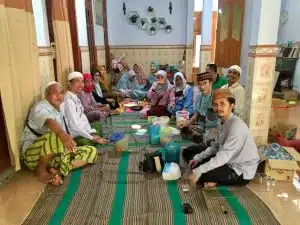
The sixth post in our alumni profile series for the 20th year of AIMEP is about Aziz Cooper, a passionate advocate for community empowerment and a member of the very first Australian AIMEP delegation to visit Indonesia in 2004!
Read his story below:
Aziz Cooper
When I was 21, just as I was moving into a big share house, another person was leaving to go to the airport. And as I passed him in the hallway, he said, “Oh, you might be interested in this,” and gave me a brochure for a community development volunteering program in India he was going to.
I’d never even thought about India in all my life, but I looked at it and thought, ‘Oh, this might be interesting’. And then the following year, I was accepted to their two-month program.

Our role was to go into the slums to provide information about nutrition and health, and we also did a bit of teaching. At first, it was very confronting for me – the sights, the smells, the poverty. And I was also living with a group of five other young men in just one room in the slum where we slept, cooked, and studied. I think the program organisers knew that we wouldn’t make much of a difference in the slums, but perhaps planned that we’d go home having learned more about ourselves. By the end of it, I knew I would be coming back. I had discovered not only that I loved helping people, but that I was fairly good at it.
I think everyone comes back from India changed. For me, India was the exact opposite to where I’d grown up – in a small country town in Queensland. And religion was totally the opposite as well. I was brought up in the Uniting Church, but in Australia, religion is often seen as a personal pursuit which you keep to yourself. In contrast, it was natural for people in India to just be totally immersed in religion, whatever religion that was, and it just oozed out of their day to day lives.
In the slums where I worked in New Delhi and Lucknow, the majority religion was Islam, and it was Sufism, the mystical branch of Islam, that particularly attracted me. The rituals and spiritual disciplines really meant something to me – the fasting, the zikr, the chanting, the meditations, and the five daily prayers. Even making wudu, the ritual washing in preparation for prayer, was exhilarating, as I found that doing something physical really engaged my spiritual side.
I ended up going back to India 12 times over the next 25 years on the same program and for business. I would just save up and go until the money ran out, then come back to Australia, work, and go again. At the same time, I explored Islam. I just jumped right in, sitting on the floor in little makeshift mosques with mud brick walls and sheet plastic roofing.

In Australia, I kept my interest in Islam to myself for the first six months or so. I did try going to the local mosque where I lived in Brisbane, but as I didn’t have a very good experience, I didn’t go back. Later, a friend hooked me up with a more welcoming mosque. And in the end, it took me around three years to come to my own place as a Muslim. My position may not be that orthodox, but that’s okay.
On my second trip to India, I met my future wife, who was in the women’s team in the same slum. We got to know each other, and as she was also living in Brisbane and had an interest in Islam, we had a lot in common. Four years later, we got married. By then, I was 25.
After that, I did various local community development jobs around Brisbane, including resettling refugees, and working with people living with disabilities. But then, in 1998, I was working with an IT company who needed someone to open their New Delhi office. I put my hand up, and although I’m not an IT person, they sent me there. Unfortunately, while there my wife and I were just constantly sick, so after a year, we came back. Although we were always intending to go back to India, in the meantime, the company asked if I would open their Melbourne office, and I agreed!

We thought we’d only be in Melbourne a couple of years, but it’s now turned out to be almost 25 years! A year or so after arriving, I decided I wasn’t really an IT person, so I resigned, and started volunteering with a peak Islamic community council, just doing some office work. Then September 11 happened, which threw the whole Muslim community into turmoil. And as a result, about two weeks later, Corrections Victoria, who run the adult prison system, were negotiating with the Islamic Council to start a professional Islamic prison chaplaincy effort to support Muslim prisoners who were feeling targeted and harassed. I was encouraged to apply, and surprisingly I was appointed as Director. Perhaps I was the only person that applied!
At that time, there were 120 Muslim prisoners, most of whom were young men. I hired imams as chaplains from the whole range of Islamic expressions, so there were Arabs of the Sunni and Shia traditions, Turks, Lebanese, Somalis, Pakistanis and Indonesians.
It was a really complex environment, with many different stakeholders who all had different agendas, including the prisoners, their families, the imams on the outside, the prison management, and the victim support lobby. Unfortunately, at times I had a rough relationship with the prisoners. They didn’t know whose side I was on, because I didn’t engage in identity politics. I would be there just teaching the mainstream Islam, take it or leave it, and unfortunately, most didn’t take it. Still, there were some fantastic success stories of men rehabilitating themselves, so even though I felt disheartened most of the time, that kept me going.

In 2004, my wife and I and another couple were actually the first Australians to do the Australia-Indonesia Muslim Exchange Program, as it was still a pilot program at that time. It was a great experience. We went to Jogjakarta and Jakarta, where we were able to meet many of the department heads of NU and Muhammadiyah, the two big Islamic organisations in Indonesia. I was surprised to hear about the hundreds of orphanages, hospitals and universities these organisations supported, as this kind of practice is not common within Muslim organisations in Australia. I was able to visit a couple of prisons and post-release support programs such as halfway houses, which was very interesting. We were also taken to the law courts, the Sultan’s palace, and to mosques, Buddhist temples and churches, as well as to cultural forums and programs, including the Ramayana ballet. Another highlight was having lunch with the Australian Ambassador to Indonesia, and the electoral commissioner of Indonesia, as well as a one-hour meeting with Abdurrahman Wahid, the former president! It was just fantastic.
One of the things that was most interesting for me about the trip was having the chance to see a different kind of Islam in practice, and to realise that Islam is very diverse. As I really saw the value of the program, once I returned, I went on to promote it to other Australians in my network and also later became part of the selection panel.

Unfortunately, after 10 years, I experienced severe burnout at my job working within the prisons, so I resigned. For a while, I had a lot of post-traumatic stress, and had to have psychological support. Eventually, I decided to do a master’s degree in Community Development in Emergency Management, which prepares communities for disasters, and post-disaster recovery.
My studies just reconfirmed to me that humanity, in a few short decades time, is in for a lot of trouble, with rising sea levels likely creating forced mass migration, conflict regarding issues like access to fresh water, and polluted land, sea and sky. Artificial intelligence is also throwing humans into unemployment.
As a result, for the last ten years, I’ve been working with interfaith and intercultural organisations to have discussions about how we are going to work together to tackle these near future issues. In my opinion, we need to form trusting relationships across cultures and faiths now, while things are still fairly good, in preparation for the near future, when humanity is going to have to rely on each other to survive.
I believe an important part of our personal growth is learning about other cultures and other faiths, and that by engaging, we become better, rounded, finer-honed individuals.
That might mean that you have to take risks at times, or leave your comfort zone, but you’ll always be glad you did it.

Aziz Cooper
Melbourne, Australia
AIMEP 2004